What do particle physics and food packaging have in common? More than you might think
Tetra Pak
Technology originally developed at CERN, the European Organization for Nuclear Research and home to some of the world's most advanced scientific experiments, is now helping Tetra Pak improve food packaging sterilisation processes, making them faster, more efficient and more sustainable.
Geant4 allows us to understand radiation interactions at a very detailed level and optimise our sterilisation processes with greater confidence.
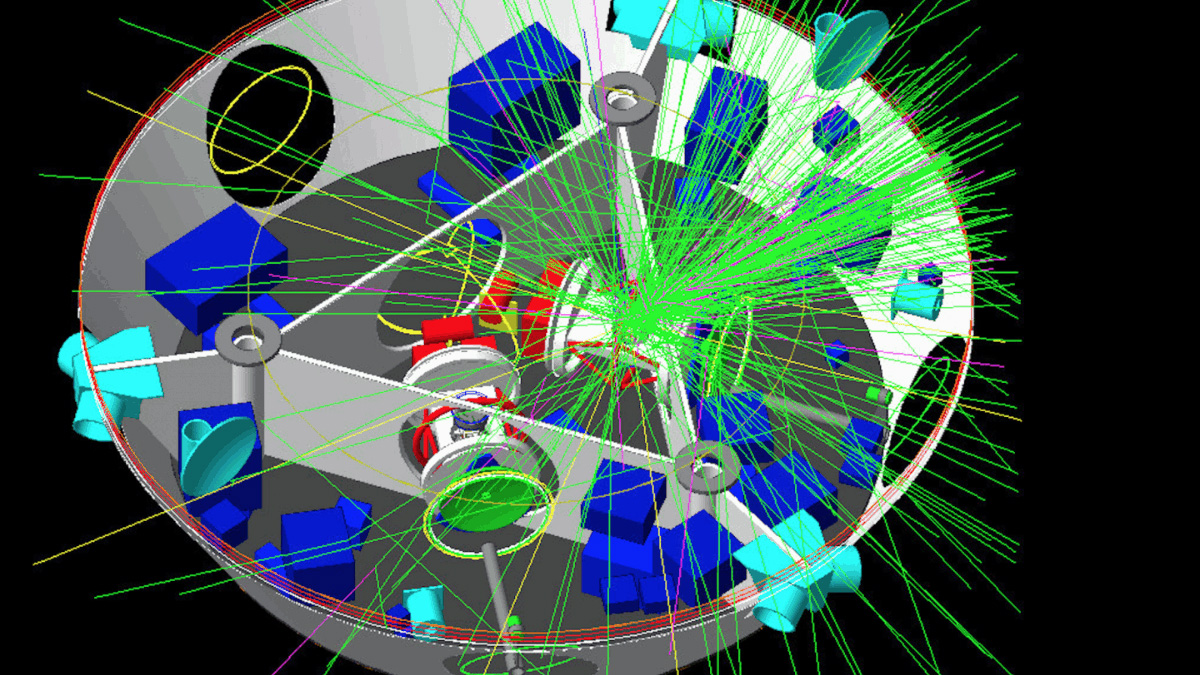
At the centre of this collaboration is Geant4, an open-source simulation toolkit developed by CERN and the international Geant4 Collaboration to model how particles and radiation interact with matter. Originally designed to support fundamental physics research, Geant4 has since found applications in fields ranging from medical physics and space research to nuclear engineering and radiation protection.
Today, Tetra Pak is using this advanced technology to better understand and optimise sterilisation processes for food packaging.
Simulating sterilisation in the digital world
Ensuring packaging is sterile is critical for food safety. Traditionally, evaluating sterilisation performance has required extensive physical testing. By using Geant4, Tetra Pak engineers can complement this work with detailed digital simulations.
The technology enables engineers to simulate how electron beams (eBeam) and ultraviolet (UV) light interact with packaging materials and microorganisms during the sterilisation process. By modelling how radiation damages the DNA of bacteria and spores, teams can assess sterilisation effectiveness with a high degree of accuracy before conducting physical trials.
“Geant4 allows us to understand radiation interactions at a very detailed level and optimise our sterilisation processes with greater confidence,” says Ulf Lindblad, Technology Specialist at Tetra Pak.
Faster, more efficient development
By providing deeper insights into how sterilisation technologies perform, the simulations help Tetra Pak reduce costly and time-consuming physical testing, optimise equipment and emitter design, and accelerate development through the use of advanced technologies such as GPU acceleration and system integration. They also help ensure the efficiency and reliability of sterilisation processes.
In addition, the simulations support broader equipment development efforts by helping engineers better understand temperature behaviour and overall system performance.
The result is a faster, more efficient development process that enables teams to innovate with greater confidence while supporting both product quality and operational performance.
The collaboration demonstrates how innovations created for fundamental scientific research can find powerful applications in industry. By transferring advanced simulation methods from CERN into food packaging development, Tetra Pak is applying cutting-edge science to solve practical challenges in food production and packaging.
It is also a strong example of how technology developed within Big Science ecosystems can create value far beyond the research laboratory, helping improve food safety, strengthen process sustainability and accelerate innovation.
Last edited 2026