12 June 2026
From Big Science to business: a career built on knowledge transfer
 Harri Hellgren, Senior System Engineer and Tech Lead at Qamcom for the SKAO project, set to become the world’s largest radio astronomy observatory.
Harri Hellgren's career is a clear example of how expertise gained in Big Science environments can flow into industry, creating value far beyond the original research project. Born and educated in Finland, Harri is an electronic and RF engineer whose career has moved between industry and major research infrastructures. After early work in industry, he spent six years at CERN, contributing to projects including LEP and CLIC.
He later returned to industry as an entrepreneur before joining EISCAT in Kiruna, where he spent eight years working on the EISCAT_3D project as Technical Head. Today, Harri works at Qamcom in Gothenburg, a Swedish engineering company and supplier to the Square Kilometre Array (SKA), the world's largest radio telescope project currently under construction in Australia and South Africa.
For Harri, the transition from research infrastructure to industry was surprisingly natural.
“The work doesn't really change,” he explains. “You sit by your computer and solve problems. It's more the surroundings and context that change.”
More than technical expertise
When discussing knowledge transfer, people often focus on technologies or inventions. Harri believes that some of the most valuable lessons from Big Science are less tangible.
“To make good work takes time, and sharing your thoughts with others always helps," he says."Having a group of people with different backgrounds gives more ideas.”
Working in large international research collaborations means learning how to tackle complex challenges alongside experts from many disciplines. According to Harri, Big Science facilities also provide a unique opportunity to understand what is technically possible.
“All Big Science facilities are different, and you gain a lot of experience by working in different places. You begin to understand what is possible to achieve and where the limits are.”
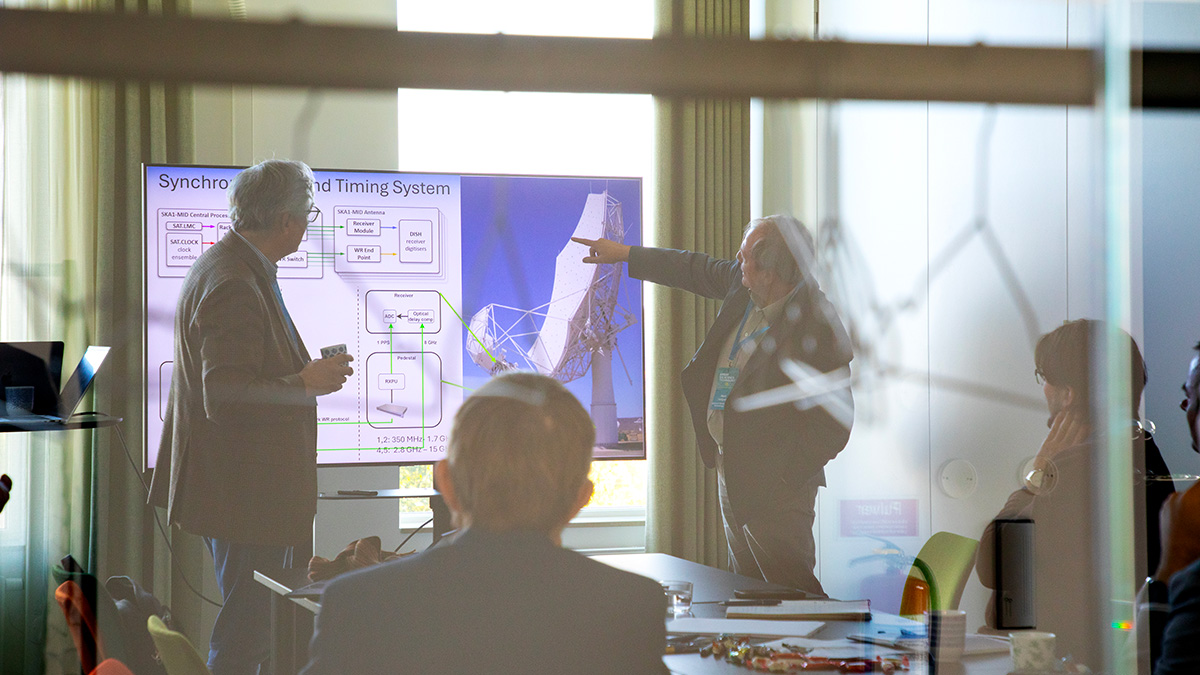
In 2025, eight of the world’s leading research facilities joined Nordic researchers and high-tech companies in Lund for AIMday Big Science Technology. Among the participants was Harri Hellgren from Qamcom, bringing experience from both Big Science facilities and industry.
A unique environment for innovation
Research infrastructures such as CERN, EISCAT and SKA are designed to answer fundamental scientific questions. In doing so, they often push technology beyond existing boundaries.
Harri sees this as one of the key reasons why these facilities generate knowledge that later becomes valuable for industry.
“In industry, we work at a faster pace and don't have as many resources to try different things,” he says.“Institutions like CERN set audacious targets for scientific discovery, driving technological progress on a scale that industry cannot match.”
The challenge comes later: finding ways to transfer that knowledge into new applications, products and services. “One of the biggest challenges is understanding how the knowledge gained can be transferred and used by clients in other areas.”
This is where collaboration between research infrastructures and industry becomes essential.
Industry as a partner from day one
Having worked on both sides of the equation, Harri is convinced that suppliers and industry partners play a critical role in the success of major scientific projects.
“Very important,” he says when asked about the role of industry. “I think one of the biggest mistakes Big Science facilities make is not involving industry from the start of a project.”
Early involvement allows companies to contribute expertise, develop new capabilities and prepare for future applications of the technologies being created. It also strengthens the long-term impact of public investments in research infrastructures.
Turning Big Science into innovation
Big Science facilities develop advanced technologies, new methods and valuable expertise that have the potential fo find applications far beyond their original purpose.
Big Science Sweden supports knowledge and technology transfer between Big Science facilities, industry and academia, helping new ideas, technologies and expertise create value in society.
Contact
Frida Tibblin Citron
Business Developer, Knowledge Transfer
frida.tibblincitron@bigsciencesweden.se
+46 76 144 33 81