From CERN detector technology to more precise cancer treatment
TERAPET
CERN spin-off Terapet is adapting particle detector technology to improve verification in proton therapy. Founded in Geneva in 2019 by two Swedish physicists and a Swiss radiation oncologist, the company brings expertise from fundamental research into medical applications.
Expertise developed at CERN is finding a new application in proton therapy, with the potential to improve precision in cancer treatment.
Addressing a challenge in proton therapy
Proton therapy uses proton beams to target tumours while minimising damage to surrounding healthy tissue. A major challenge is verifying where the protons deposit their energy inside the patient.
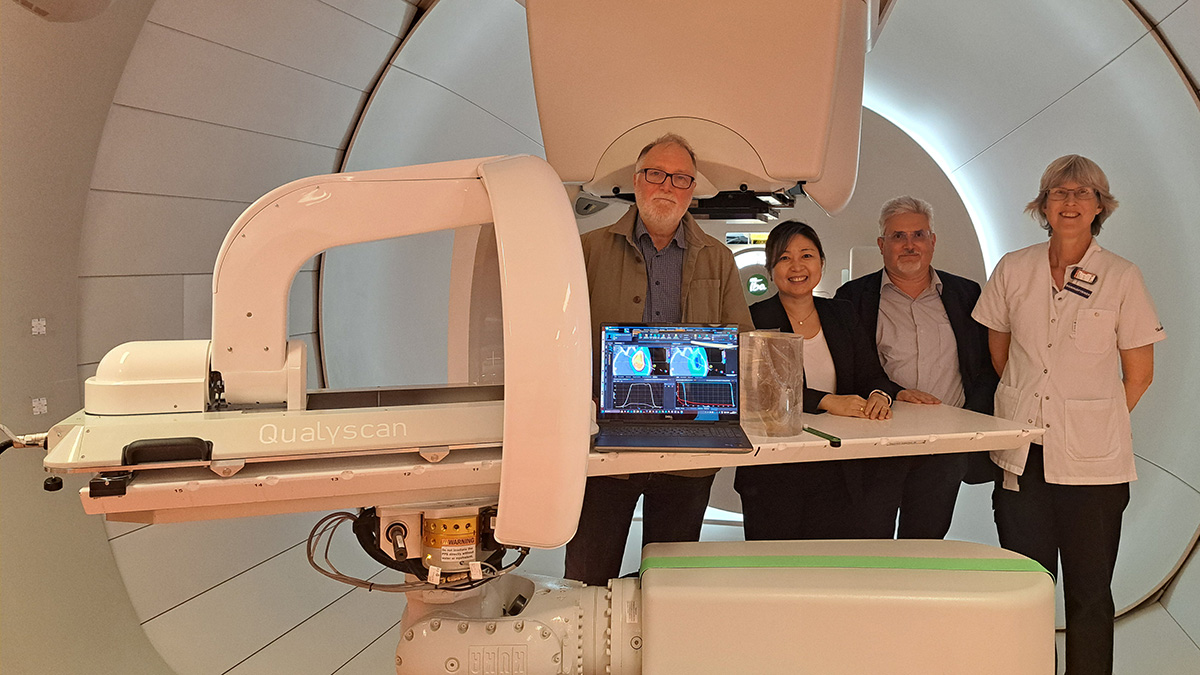
Terapet is developing PET-based imaging solutions to improve treatment verification. Its first major product, Qualyscan, uses detector technology derived from high-energy physics to measure and visualise the delivered proton dose. The aim is to support more precise treatment through improved verification of dose delivery.
Combining CERN expertise with Swedish clinical research
Terapet was founded by Swedish physicists Christina Vallgren and Marcus Palm, together with Swiss radiation oncologist Professor Raymond Miralbell. Vallgren and Palm each spent more than a decade at CERN. Their experience in particle detection, combined with Miralbell’s clinical expertise, laid the foundation for the company.
The development of Qualyscan involved R&D collaborations with CERN, Karolinska Institutet and Skandion Clinic in Sweden. Skandion Clinic provided the clinical environment for testing and validation using proton beams, connecting detector development with the requirements of cancer treatment.
From detector development to clinical applications
Qualyscan shows how technology developed for particle physics can be adapted to address a practical challenge in healthcare. Improved verification of proton dose delivery has the potential to make treatment more precise and safer.
Terapet is continuing this work through TheraVivo, a European collaboration involving Swedish partners RaySearch Laboratories, Uppsala University and Skandion Clinic. The collaboration focuses on in-vivo treatment verification and adaptive proton therapy.
The company illustrates how expertise gained at CERN can form the basis of a new business. Swedish research and clinical partners are helping bring that expertise closer to applications in cancer care.
Last edited 2026